
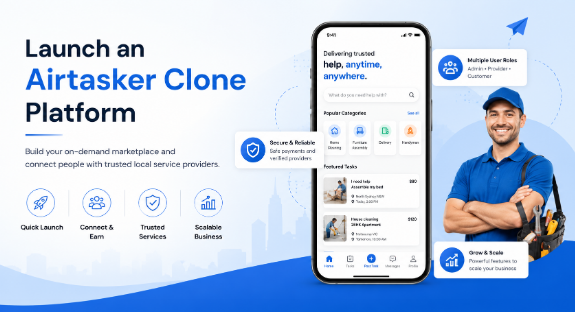
Building an on-demand marketplace has become one of the most practical digital business models in recent years. A platform like airtasker clone is designed to connect users who need tasks completed with service providers who can fulfill them in real time. This model powers platforms similar to an App like Airtasker or an On-Demand Handyman App Like TaskRabbit, where convenience, speed, and trust drive engagement.
However, launching such a platform is not just about coding an app. It involves structured planning, technology decisions, scalability considerations, and long-term operational strategy. This guide walks through the entire lifecycle—from concept to deployment—focusing purely on the technical and product-building aspects.
Understanding the Airtasker-Like Marketplace Model
An airtasker clone is fundamentally a two-sided marketplace platform. One side represents customers who post tasks, and the other represents service providers who complete them. The platform acts as an intermediary that manages discovery, booking, payments, and trust.
The system typically operates on real-time task allocation or bidding-based assignment depending on business rules. Some platforms allow instant booking, while others let service providers place bids on tasks.
From a technical standpoint, this model requires handling complex interactions such as matching algorithms, real-time notifications, and secure payment flows. These components form the foundation of any App like Airtasker.
Defining the Core Problem Statement Before Development
Before writing a single line of code, it is essential to define the problem the platform will solve. Most airtasker clone platforms fail when they try to replicate features without understanding user behavior or market demand.
A clear problem statement should define:
- What type of services will be offered (handyman, cleaning, logistics, freelance tasks)
- Geographic scope (local city-based or multi-region scaling)
- Target users (individuals, SMEs, or enterprises)
- Task completion workflow (instant booking or bidding model)
For example, an On-Demand Handyman App Like TaskRabbit focuses heavily on local service availability and fast response time, which impacts backend architecture and real-time systems design.
Planning the System Architecture
A scalable airtasker clone platform must be designed using modular architecture. Monolithic systems may work for MVPs but fail under high demand and geographic expansion.
Key architectural components include:
- User management service (customers and service providers)
- Task management system (creation, updates, lifecycle tracking)
- Matching engine (assigning tasks to providers)
- Payment gateway integration module
- Notification service (push, email, SMS)
- Admin dashboard backend
Most modern platforms use microservices architecture with API gateways to manage traffic efficiently. This approach ensures independent scaling of components like payments and task matching.
Choosing the Right Technology Stack
Selecting the correct technology stack is critical for building a reliable airtasker clone platform.
Frontend technologies:
- React.js or Next.js for web applications
- Flutter or React Native for mobile apps
Backend technologies:
- Node.js for event-driven systems
- Python (Django/FastAPI) for structured APIs
- Java (Spring Boot) for enterprise scalability
Database systems:
- PostgreSQL for relational data (users, transactions)
- MongoDB for flexible task-related data
- Redis for caching and real-time updates
Infrastructure:
- AWS, Google Cloud, or Azure for cloud hosting
- Kubernetes for container orchestration
- WebSockets for real-time communication
An experienced App development company typically evaluates these choices based on expected traffic, budget, and scaling requirements.
Designing the MVP for Faster Launch
An MVP (Minimum Viable Product) is the most efficient way to launch an airtasker clone platform. Instead of building all features at once, the MVP focuses on essential functionality.
Core MVP features include:
- User registration and authentication
- Task posting and listing
- Service provider profiles
- Basic search and filtering
- Payment integration
- Simple messaging system
Advanced features like AI-based matching, dynamic pricing, and automated dispute resolution can be added later. This phased approach reduces development risk and speeds up time to market.
Building the Matching and Allocation System
The matching engine is the heart of any App like Airtasker. It determines how tasks are assigned to service providers.
There are typically three models:
- Manual bidding system (providers bid on tasks)
- Auto-matching system (algorithm assigns based on availability and ratings)
- Hybrid system (combination of both)
A scalable airtasker clone uses ranking algorithms that consider:
- Distance between provider and customer
- Service category match
- Ratings and reviews
- Availability status
- Historical performance
Machine learning models can later enhance accuracy, but rule-based systems are usually sufficient for initial deployment.
Payment Gateway and Transaction Flow Design
Secure payment handling is critical for trust in any marketplace. The platform must support escrow-based payments where funds are held until task completion.
A typical flow includes:
- User pays at booking time
- Payment is held in escrow
- Provider completes the task
- Funds are released after approval
Integration with gateways like Stripe, Razorpay, or PayPal ensures secure transactions. For an On-Demand Handyman App, split payments and commission tracking are also essential.
Building Trust and Safety Mechanisms
Trust is a core requirement for any airtasker clone platform. Without it, user retention drops significantly.
Key systems include:
- Identity verification (KYC for service providers)
- Ratings and reviews system
- Background checks for sensitive services
- In-app chat monitoring (for safety compliance)
- Dispute resolution workflow
These features are not optional; they define whether users feel safe using the platform.
Real-Time Communication and Notification System
Real-time communication is essential for task updates and coordination. WebSockets or Firebase are commonly used to enable instant messaging and status updates.
Notification systems should handle:
- Task acceptance alerts
- Payment confirmations
- Task progress updates
- Completion notifications
An efficient notification engine reduces delays and improves platform responsiveness, especially in high-demand scenarios.
Admin Panel and Platform Governance
An admin dashboard is required to manage the entire airtasker clone ecosystem. It allows operators to control users, transactions, and disputes.
Core admin features include:
- User management
- Service category control
- Payment tracking and reports
- Fraud detection monitoring
- Content moderation tools
This layer ensures the platform remains stable and compliant with operational rules.
Testing, QA, and Performance Optimization
Before launching, extensive testing ensures system reliability. Load testing is particularly important for marketplace apps.
Testing types include:
- Functional testing for workflows
- Load testing for high traffic scenarios
- Security testing for payment systems
- Usability testing for UI/UX flows
Performance optimization often focuses on database indexing, API response times, and caching strategies.
Deployment Strategy and Scaling Plan
Deployment of an airtasker clone should follow a phased rollout strategy. Starting with a single region allows teams to monitor system behavior before scaling.
Deployment steps:
- Set up CI/CD pipelines for automated deployment
- Deploy backend services on cloud infrastructure
- Use CDN for faster content delivery
- Enable monitoring tools like Prometheus or Datadog
Scaling strategies include horizontal scaling of microservices and database replication.
Post-Launch Improvements and Iteration
After launch, continuous iteration is essential. User behavior data helps refine features and improve matching efficiency.
Common post-launch enhancements include:
- AI-based task recommendations
- Dynamic pricing models
- Advanced analytics dashboards
- Subscription-based service models
- Automation in dispute handling
Platforms that evolve quickly tend to outperform competitors in the on-demand economy.
Cost and Strategic Considerations for Building the Platform
Investing in an airtasker clone requires careful budgeting across development, infrastructure, and operations.
Key cost drivers include:
- Mobile and web app development
- Backend architecture setup
- Cloud infrastructure costs
- Third-party API integrations
- Ongoing maintenance and scaling
Businesses often partner with an App development company to reduce technical complexity and accelerate time-to-market. However, internal technical ownership is still critical for long-term success.
Conclusion
Building an airtasker clone platform is a structured engineering process that requires careful planning across product design, backend architecture, real-time systems, payments, and scalability. It is not just a mobile application but a full ecosystem that connects users and service providers in real time.
If you are developing an app like Airtasker or any other, success depends on how well the platform handles trust, matching efficiency, and scalability from day one.
A well-planned architecture combined with phased deployment ensures the platform is not only functional at launch but also capable of growing into a large-scale marketplace.